Most bioinks — the squishy gels used to 3D print living tissue — are exotic, expensive, and often derived from animals. A team at BITS Pilani's K.K. Birla Goa Campus went the other direction. They mixed three powders you could pull off a pharmaceutical supply shelf, and printed both skin repair scaffolds and custom chewable tablets with the same gel.
The recipe is refreshingly boring, which is the whole point. Starch 1500, a modified maize starch, thickens the mix so it holds a bead instead of puddling. Maltodextrin keeps it flowing smoothly through the nozzle. Sodium alginate is the setter — dunk the printed part in calcium chloride and the gel locks into a solid. All three are animal-free and already cleared for regulated food and pharmaceutical use, which is a big deal. Batch-to-batch consistency and a shorter regulatory path are usually the two things that kill a promising bioink before it ever reaches a clinic.
The printed results held up. Freeze-dried scaffolds came out with an average pore size of 39.2 µm and roughly 62.7% porosity — inside the 60–90% window researchers consider favorable for wound healing, because cells need open space to migrate into and nutrients need somewhere to travel. The same gel was also printed into chewable tablets, meaning a pharmacist could in principle dial a dose to a specific patient instead of picking the nearest off-the-shelf strength.
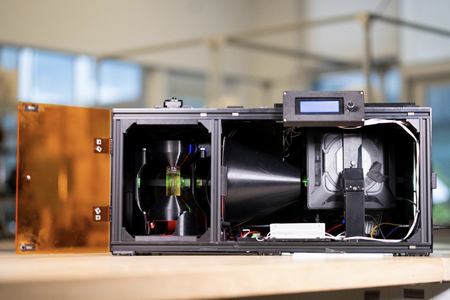
The mechanics here will look familiar if you have ever printed anything. A paste extruder is just a syringe driven by a stepper motor instead of a hobbed gear pulling filament. Flow rate, nozzle diameter, layer height, and travel speed all do the same jobs they do in FDM. The difference is that your material sets by chemistry rather than by cooling, so the shape has to survive the seconds between leaving the nozzle and hitting the crosslinking bath. Too runny and it slumps; too stiff and it clogs. That balancing act is exactly what those three powders are tuned to solve.
Try it on your printer
You are not printing tissue at home, and you should not try to print anything you plan to eat or apply to skin. But paste printing itself is genuinely accessible. Bolt-on syringe extruders exist for most open-frame FDM machines, and people use them for ceramic clay, silicone, chocolate, and icing. Start with a 0.8 mm nozzle, drop your print speed to around 10 mm/s, and expect to spend an evening tuning extrusion multiplier by hand. If that sounds like your kind of weekend, we stock the printers, nozzles, and spare parts to build on over at Flarelab — and our team is happy to talk through what your machine can handle before you buy anything.
Frequently asked questions
What is a bioink, exactly?
It is a printable gel designed to hold a shape long enough to become a scaffold, and in some cases to carry living cells. Unlike filament, it does not melt and re-solidify — it sets through a chemical reaction or a change in temperature.
Can I print this hydrogel on a normal FDM 3D printer?
Not with a standard hot end. You would need a paste or syringe extruder, which replaces the filament drive with a motor-driven plunger. The motion system and slicer stay the same, so many hobby printers can be converted.
Why does pore size matter in a printed scaffold?
Cells have to migrate into the structure and nutrients have to reach them. Pores that are too small choke that process, and pores that are too large leave the scaffold weak. The 60–90% porosity range is a common target for wound healing work.
Is 3D printed medication actually a real thing?
Yes. The first 3D printed drug approved by the US FDA arrived in 2015, and research like this pushes toward dose-on-demand tablets tailored to individual patients rather than fixed factory strengths.
Reported originally by 3D Printing Industry. Rewritten and expanded for beginner makers by the Flarelab team. Research published in the Journal of Biological Engineering.