An awards ceremony in Ohio probably is not what you picture when you think about 3D printing. But the announcement that came out of Youngstown this month is a good excuse to explain an organisation that quietly shapes a lot of what ends up on your printer.
Nine additive manufacturing Ambassadors were named for 2026. A separate honour, the Distinguished Collaborator Award, went to Brett Conner, Ph.D., who serves as Chief Manufacturing Officer at SME (the Society of Manufacturing Engineers). The announcements came at the institute's Members Meeting and Exchange, held on 4–5 August. The Ambassador programme has been running since 2017 and singles out people who put real, sustained effort into growing the field rather than simply working in it.
So what is America Makes? It is the United States' national institute for additive manufacturing — a partnership that pulls together federal agencies, universities, and manufacturers so they are not each solving the same problem in isolation. Its output is mostly unglamorous: material databases, repeatability studies, qualification methods, training curricula. None of that ships in a box. All of it slowly changes what "normal" looks like for the rest of us.
That trickle-down is the part worth caring about. When a research group establishes how a polymer behaves across a temperature range, that knowledge eventually lands in a filament datasheet. When someone publishes a rigorous method for proving a printed part is sound, that thinking reshapes how tutorials teach you to test your own prints. The gap between an aerospace lab and a bedroom printer is enormous in budget and tiny in physics.
Try it on your printer
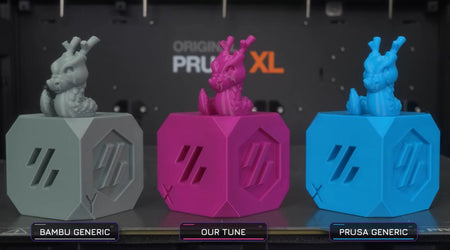
Borrow the method, not the machinery. Pick one setting you have never deliberately tested — nozzle temperature is the easiest — and print the same small model five times, changing only that value in 5 °C steps. Label each print with a marker as it comes off the bed. Write the results down somewhere permanent instead of trusting memory. Within an afternoon you will own a tuned profile for that filament that beats any generic preset, and you will have run a genuine experiment. That is exactly the discipline institutes like America Makes exist to formalise. Browse the filaments and printer gear we stock at Flarelab and start your own test log.
Frequently asked questions
What is America Makes in plain English?
It is a public-private institute in Youngstown, Ohio that coordinates additive manufacturing research between government agencies, universities and industry. Think of it as a shared lab and standards table rather than a company that sells printers.
Does anything it does reach desktop 3D printing?
Indirectly, yes. Material testing data, print-parameter research and process-qualification methods tend to filter down into slicer defaults, filament spec sheets and the tuning guides hobbyists rely on.
What is an Ambassador award?
It is recognition for people who spend significant personal effort growing the additive community through teaching, mentoring, standards work or outreach. It is a service award, not a product prize.
Do I need industrial gear to apply any of this?
No. The useful takeaway for a hobbyist is the mindset: document your settings, test one variable at a time, and keep records so results repeat. That works the same on a $200 printer.
Reported by 3D Printing Industry. Rewritten and expanded for beginners by Flarelab.