Sometimes the most important prints aren't flashy — they're the ones that make precision possible.
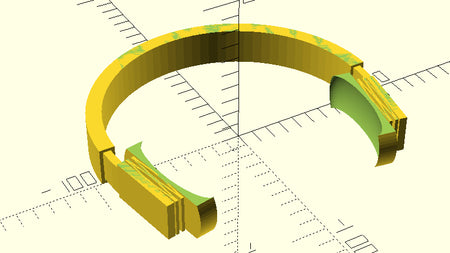
This Template Casting project was a client request designed for one key purpose: to serve as a 3D-printed mold template for casting and fit-checking.
The client provided precise measurements, and from there we modeled and prepared the file for print. Since the object exceeded our printer's build volume, we carefully sliced it into smaller sections to ensure each piece maintained dimensional accuracy once assembled.
Printing with Precision
The entire print was done in black filament, chosen for its clean, professional look and durable finish — ideal for repeated handling and use in casting setups.
Total printing time: 11 hours and 41 minutes
Print strategy: multiple sections, optimized layout for dimensional integrity
Every piece had to align perfectly, not just for looks, but for function — the final output had to match the original design specs down to the millimeter.
Why It Matters
This project showcases how 3D printing complements traditional fabrication. By prototyping a casting template in-house, the client could verify fit and form early, saving both time and material in later stages of production.
For FlareLab, it's another reminder that not every great print is meant to be seen — some are made to make other things possible.
Materials Used
Black Filament
Final Thoughts
The Template Casting project proves that precision and practicality can go hand-in-hand. Whether it's for casting, checking, or creating, 3D printing continues to make complex manufacturing faster, smarter, and more accessible — one layer at a time.
Frequently asked questions
What is a casting template used for?
A casting template is a precision reference part used to verify dimensions, check fit, or guide a casting process before committing to expensive metal or resin production. 3D printing one in-house catches design issues early.
Why split the print into multiple sections?
The original part was larger than the printer's build volume, so dividing it into print-friendly sections kept dimensional accuracy intact. With proper alignment keys, the assembled template matches the original design within a fraction of a millimeter.
What filament is best for casting templates?
PETG and PLA+ both work well. PETG handles repeated handling and slight temperature changes better, while PLA+ holds tight tolerances. Black filament is preferred because it shows surface details under workshop lighting.
How accurate is a 3D-printed casting template?
With a well-calibrated FDM printer, you can hit ±0.1–0.2 mm accuracy on small features and ±0.3 mm on larger ones. For tighter tolerances, an SLA resin print or post-machined surface gives better results.
How long does a print like this take?
This template took 11 hours 41 minutes across multiple sections. Templates of similar complexity typically run 8–20 hours depending on size and infill density.
Can Flarelab print custom casting templates for my project?
Yes. Send measurements, drawings, or a CAD file to flarelab.com and the team will plan section splits, print, and ship a precision template ready for your casting setup.